Hikkaduwa has been drawing divers into its waters for decades, long enough to have built a genuine culture around the sport. The reefs here are protected, and the town has grown up around an understanding that what lies beneath the surface is worth preserving. It is a lesson that diving teaches you again and again: it is all too easy to disregard what you cannot see. Getting underwater changes that. It reminds you of what needs our attention.
Our base for the Open Water qualification was Poseidon Dive Centre, a 5-Star PADI operation that sits comfortably at the more serious end of the spectrum without ever making you feel like you need to earn your place there. Some dive centres carry an air of the exclusive, a closed-door feeling that can make the uninitiated feel unwelcome. Poseidon was the opposite. The whole team radiated a quiet pride in what they had built: something safe, welcoming and genuinely laid back. Our instructor, Praveen, embodied all of that.
With no pool on site, our confined water skills sessions took place in the shallows of Hikkaduwa beach. This meant the mask flooding and recovery exercises had an extra salty sting to them out there in the open sea. After lunch, it was time for our first boat dive, at a local site simply known as The Cave, twelve metres down.
Tipping yourself backwards off the side of a boat is perfectly routine for even the most inexperienced diver. But there is real novelty in entering the water head-first and upside down for the first time, as the marine world reveals itself in a rush from above. Down at the bottom, a tangle of rock and coral made for the perfect theatre for nature’s game of hide and seek, fish darting and weaving through gaps as they hunted and were hunted in turn. I caught my first glimpse of an iridescent parrotfish, hanging in the blue, shimmering in the dappled light that manages to reach the reef bed. This was also the first chance to put our dive theory into practice, drawing on the various e-learning modules and exams we had completed before arriving in Sri Lanka. In the early stages, every action feels clunky and alien. There were moments when I felt I was simply flailing. Praveen absorbed all of it with patience, offering clear guidance, whether that was a conversation on the surface or a sequence of hand signals on the bottom.
The following morning, after a quick session practising underwater navigation with a compass along Hikkaduwa beach, we were straight into a dive briefing, then wading out to the boat with all our gear for the wreck dives. Our first stop was the SS Conch, one of the earliest oil tankers ever built. Constructed in 1892 for the Shell Transport and Trading Company, she weighed over 3,500 tons and was bound from Novorossiysk to Madras when, in June 1903, she struck the Akurala reef and broke in two. She now lies on her port side at around twenty metres at her lowest point, spread across roughly a hundred metres of seabed, her boilers and engine room still recognisable more than a century on. Over time she has become an artificial reef in her own right, and the visibility, steadied by the rocky bottom, is generous.
We surfaced after about forty-five minutes and returned to the boat, passing around biscuits during the surface interval as we made our way to the second site. The Earl of Shaftesbury has been on the bottom for even longer. An iron-hulled British sailing cargo vessel with four masts and a length of around 88 metres, she was making her way around Sri Lanka in May 1893, running in ballast after unloading in Bombay, when she was caught by rough seas and struck a reef. Six of her crew were lost. She settled into the sandy bottom at around fourteen metres, and over a century of coral growth has softened her outlines into something almost organic. A shallower dive than the Conch, but no less exhilarating. I missed a barracuda sighting while fiddling with my submersible pressure gauge, though I did manage to spot a well-camouflaged pufferfish lurking amidst the remains of the ship’s top deck.
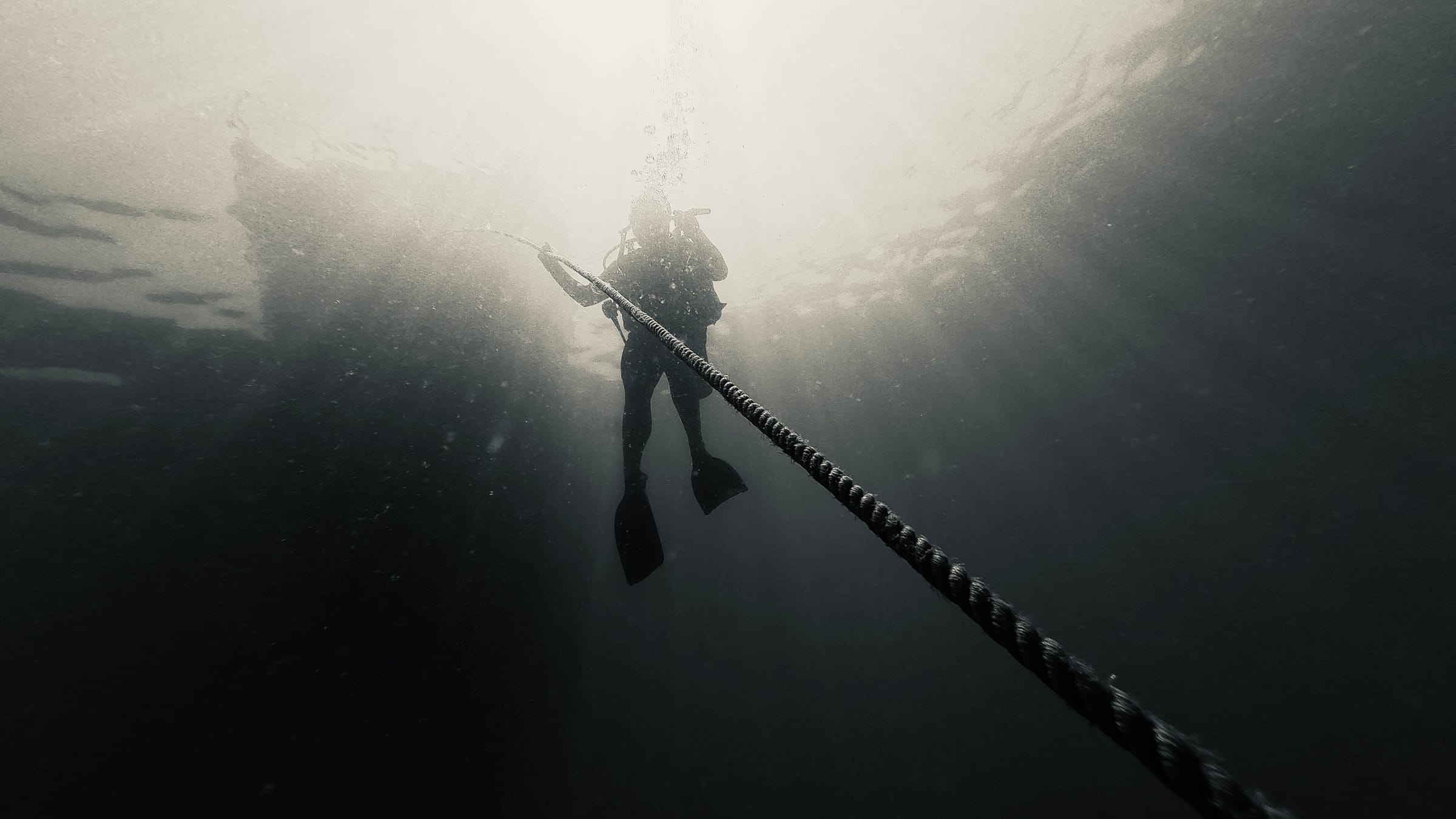
The final skill to complete was the controlled emergency swimming ascent, up to the surface marker buoy we had deployed, which marked the end of all four open water dives. Back on dry land, there was one last piece of the qualification to attend to: the logbook, that small but important document that travels with a diver everywhere and serves as evidence of their skills and experience, wherever in the world they happen to find themselves underwater. Right now, mine is straightforward evidence of how green I am. A complete beginner. But I’m already working on that.
In a few weeks, we will be meeting Praveen and the Poseidon team again, this time on the north-east coast as the dive season opens at Trincomalee. The advanced open water qualification awaits, diving to thirty metres, new skills to master and a growing familiarity with this life below the surface.